There is a quiet revolution happening in education, and it does not look like what most people expect. No chatbots replacing teachers. No gamified apps drilling multiplication tables. Instead, families across the country are rediscovering something older, something proven, and something that turns out to be remarkably well-suited for the world their children are about to inherit.
The future of education might look a lot like the past.
What “Classical” Actually Means
Classical education gets mischaracterized as dusty or elitist, but that misses the point entirely. At its core, classical education is about teaching children how to think, not just what to think. It draws on the Great Books tradition, training young minds to read primary sources, wrestle with big ideas, articulate arguments, and evaluate evidence. It emphasizes logic, rhetoric, and reasoning at every stage of development.
The result is a scholar who can adapt, analyze, and communicate, which are exactly the skills that matter most in a world where information is abundant and judgment is scarce.
Why Now? Why Classical?
The timing is not a coincidence. As technology accelerates and the pace of change intensifies, families are asking harder questions about what school is actually for. Memorizing facts? Algorithms handle that. Following instructions? So do robots. What remains distinctly human and distinctly valuable is the capacity for critical thought, nuanced reading, and substantive discourse.
Classical education has always been about developing exactly those capacities. The Great Books curriculum did not survive for centuries because it was fashionable. It survived because it works.
Studies in cognitive science continue to back this up. Deep reading of complex texts builds neural pathways that shallow content consumption does not. Socratic dialogue sharpens reasoning in ways passive instruction cannot replicate. The classical model turns out to be remarkably aligned with how human brains actually develop understanding.
Classical and Cutting-Edge Are Not Opposites
Here is where the conversation gets interesting. Many families assume classical education means choosing the past over the future, opting out of technology in favor of tradition. That is a false choice.
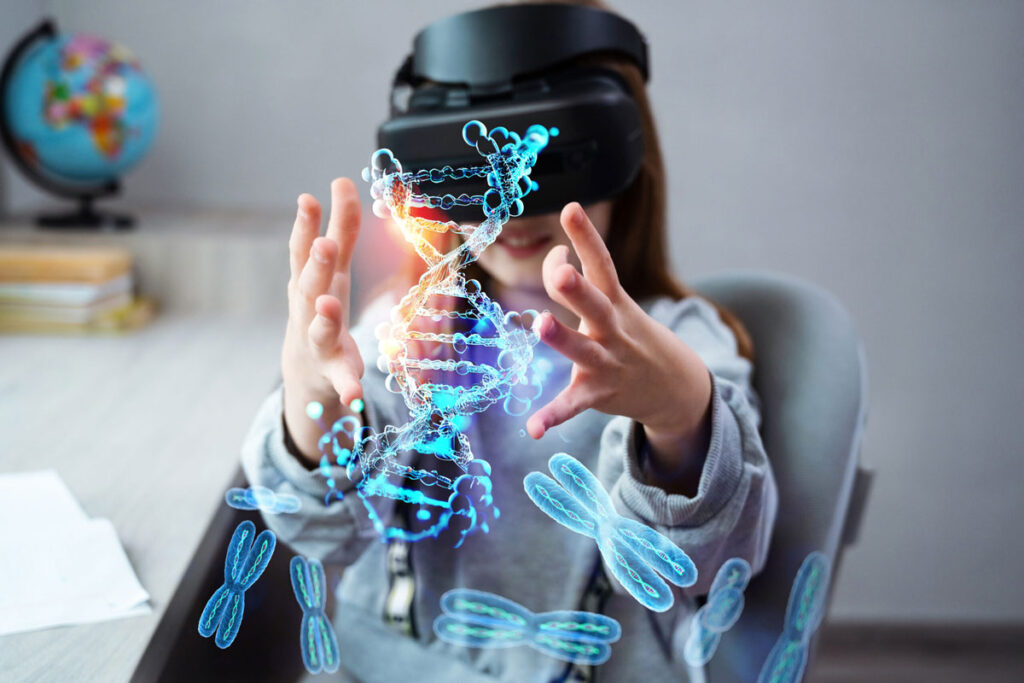
At Optima Academy Online, the classical curriculum and immersive virtual reality learning exist in the same classroom. Scholars read the same foundational texts that shaped Western civilization. They also put on a headset and explore ancient Rome in three dimensions. The Great Books provide the questions; the technology deepens the experience of finding answers.
This combination matters because it develops scholars who are not just digitally fluent. They are historically literate, ethically grounded, and genuinely curious. That combination is rare. It is also increasingly essential.
The Socialization Question
One of the most persistent myths about classical online education is that scholars miss out on meaningful social connection. The reality is more nuanced. Classical education has always been deeply collaborative, built around discussion, debate, shared reading, and the exchange of ideas. At OAO, live teacher-led instruction means scholars are arguing over Socrates and analyzing Lincoln on the same day, together, in real time.
The social dimension of classical learning is not incidental. It is central to the model. Scholars learn to listen, to disagree respectfully, and to build on each other’s thinking, skills that translate directly into adult civic and professional life.
A Better Way to Do School
The four-day school week. Shorter days. No weekend homework. On the surface, these might sound like conveniences. They are actually design choices rooted in what the research says about learning, attention, and family health.
Children learn better when they are not exhausted. Families function better when school does not consume every waking hour. Scholars who have breathing room develop the kind of independent intellectual habits that classical education is specifically designed to cultivate.
The classical model was never meant to fill every hour with content delivery. It was meant to develop people who love learning and who pursue it long after the school day ends.
What Families Are Really Looking For
When families choose a classical education for their scholars, they are making a statement about what they believe education is for. Not credential accumulation. Not test prep. Not compliance training.
They want their children to be thinkers. Readers. Communicators. People who can hold a complex idea in their mind, turn it over, examine it honestly, and say something true about it.
That aspiration is ancient. The tools for delivering it are brand new. The combination is what the future of education actually looks like.