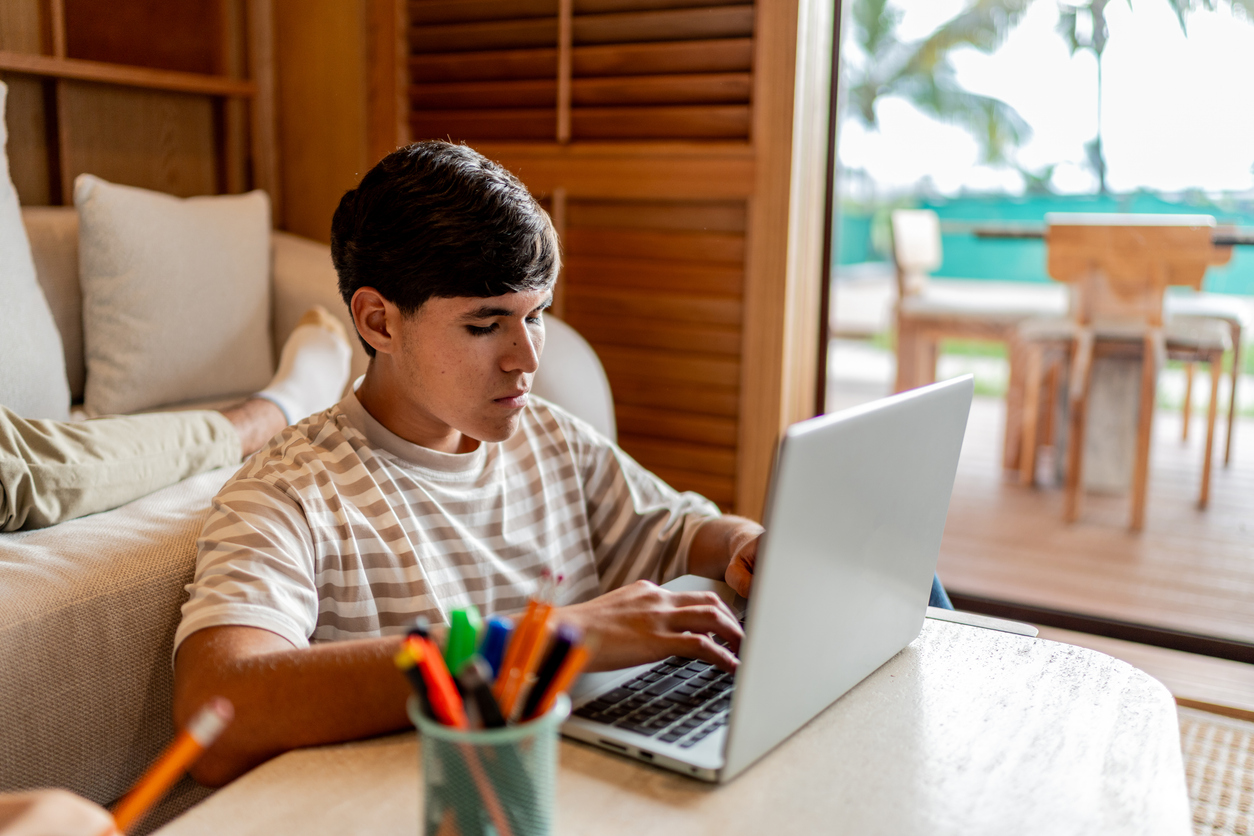
Shopping for online school can feel like navigating a maze. You find a program you like, then realize it is state-funded. Another looks great, then you discover it is private and tuition-based. And then there is the question every parent eventually asks: does it even matter?
It matters more than most families realize. The differences between public and private online schools touch curriculum, accountability, flexibility, cost, and fit. Understanding those differences upfront saves you time, frustration, and potentially thousands of dollars.
Here is what you need to know before you choose.
The Basics: How Each Model Works
Public Online Schools
Public online schools, sometimes called virtual charter schools or virtual public schools, are funded by taxpayer dollars and governed by state education agencies. They operate under the same regulations as traditional public schools, including state curriculum standards, standardized testing requirements, and enrollment restrictions based on residency.
They are free to attend. In exchange, families give up a significant amount of flexibility. Public online schools must follow the state’s academic calendar, administer required state assessments, and often mandate set daily login hours to track attendance.
Private Online Schools
Private online schools are independently operated and funded through tuition, donations, grants, or education savings account (ESA) programs. They answer to accrediting bodies and their own governing boards, not state curriculum mandates.
Private schools set their own academic standards, develop their own curriculum, and design their own schedules. Families pay tuition, but in states with ESA or scholarship programs, that cost can often be offset significantly through state-funded accounts.
The core trade-off: public online schools offer no-cost enrollment; private online schools offer design freedom that public programs simply cannot provide.
Key Differences Side by Side
Curriculum and Academic Standards
Public online schools must align their curriculum to state academic standards. Teachers deliver state-approved content in a sequence designed to meet standardized testing benchmarks. There is little room for deviation.
Private online schools design their own curriculum. Some adopt classical or literature-based models. Others focus on project-based or mastery learning. The best private programs build coherent, rigorous academic tracks that go far beyond test prep.
Schedule and Flexibility
Public online schools are more flexible than a traditional brick-and-mortar school, but they still have to comply with state regulations. Most require scholars to be logged in during set hours, follow a district calendar with specific holidays, and complete assignments within rigid windows.
Private online schools vary widely, but the best ones are built around the family’s real life. Optima Academy Online runs on a four-day school week with shorter instructional days and no weekend homework, because scholars should have time to be kids. Live, teacher-led instruction happens at scheduled times, but families retain far more control over their days.
Accreditation
Both types of schools can be accredited, but the accrediting bodies differ. Public schools are typically accredited through state agencies or regional bodies. Private schools pursue independent accreditation to signal quality and rigor.
Optima Academy Online is accredited by Cognia, one of the most respected accrediting organizations in K-12 education. Cognia accreditation means rigorous standards for curriculum quality, teaching effectiveness, and institutional governance, not just state compliance.
Cost
Public online schools are free, which is a real advantage for many families. If budget is the deciding factor and the curriculum and schedule meet your family’s needs, a public virtual school may be the right call.
Private online schools charge tuition, but the funding landscape has changed considerably. Florida families can use Step Up for Students scholarships. Texas families can tap the Texas ESA (TEFA) program. These education savings accounts can cover private school tuition, often substantially, for families who qualify.
It is also worth noting that in Florida, Optima Academy Online operates as both a public and a private school option depending on how a family enrolls. In all other states, OAO is a private school. Families outside Florida exploring OAO should factor tuition and available ESA funding into their planning.
For families who qualify for these programs, a private online school may be more accessible than they expect.
In Florida and Texas, state-funded education savings accounts can make private online school tuition more affordable than many families realize.
Who Is Each Model Right For?
Public Online School May Be a Good Fit If…
- Tuition is a barrier and you do not qualify for ESA or scholarship funding
- Your scholar thrives within standard state academic frameworks
- You prefer a familiar academic structure with state oversight
- You need the school to follow a standard district calendar
Private Online School May Be a Better Fit If…
- You want a rigorous, coherent curriculum not constrained by state testing mandates
- Your family’s schedule requires genuine flexibility, not just nominal flexibility
- Your scholar has a learning difference, IEP, or needs dyslexia-friendly instruction and tools
- You are transitioning from homeschooling and want structure without sacrificing freedom
- You value personal teacher relationships, live instruction, and a school that knows your scholar by name
- You qualify for a state ESA or scholarship program and want more control over how those funds are used
A Word on Virtual Reality: Not All Schools Are the Same
One of the fastest-growing differentiators among private online schools is immersive technology. Optima Academy Online has built VR directly into the academic model, not as an add-on or gimmick, but as a core instructional tool.
When scholars study ancient Rome, they walk through the Forum. When they analyze Shakespeare, they inhabit the Globe Theatre. This level of experiential learning is not available in public virtual school programs, and it is not something that can be replicated through a browser tab.
If your family is weighing options and wants to understand what school in VR actually looks like, we invite you to see it firsthand.
The Bottom Line
Public online schools and private online schools are not the same thing wearing different price tags. They reflect fundamentally different philosophies about what school is for, who controls the learning experience, and what a scholar’s day should look like.
If your family wants more than a virtual version of a traditional school experience, a private online school may be worth the closer look. Especially if ESA or scholarship funding puts it within reach.
Optima Academy Online is a Cognia-accredited, K-12 online school serving scholars in Florida, Texas, and nation-wide. In Florida, OAO serves families as both a public and private school option. In Texas and across the rest of the country, OAO is a private school. We combine a classical academic foundation with immersive VR learning, live teacher-led instruction, four-day school weeks, and an unwavering commitment to the whole scholar. If you would like to learn more or schedule a 15-minute conversation with an admissions team member, we would love to connect.