By: Dr. Kim Abel // Edited By: Dr. Reed Randall
Before school started this year, a group of our students strapped on headsets for social hour and walked straight onto the moon.
Mr. Birchum was waiting for them. He had rigged a word bank to crash onto the lunar surface. Students ran across the terrain collecting words scattered across the ground, hauled them back to their moon homes, and competed to build the longest sentence they could defend.
The whole time, Mr. Birchum spoke over “big voice” so every student could hear him, dropping gentle reminders about parts of speech as sentences got longer and stranger. Kids built grammatically correct sentences that were also, by design, hilarious. Then they illustrated their favorites on VR whiteboards.
Nobody assigned a worksheet. Nobody lost recess. There was obviously learning happening. There was also, just as obviously, play. The two occurred simultaneously.
I call what happened on that moon spatial play.
A definition
Spatial play is learning that uses a persistent, embodied location to give a problem its context. The location drives the learning. Students stand inside it, move through it, and solve a problem that only makes sense because of where they are. The moon is the reason the word bank crashed, the reason students had to run, the reason “home” was a place worth defending with a good sentence.
Add adaptive and agentic AI and the space becomes individualized. The moon is a place astronauts and students from around the world might stand on together, so an agent inside the scene can adapt the language itself, translating vocabulary or shifting complexity to match each student’s level.
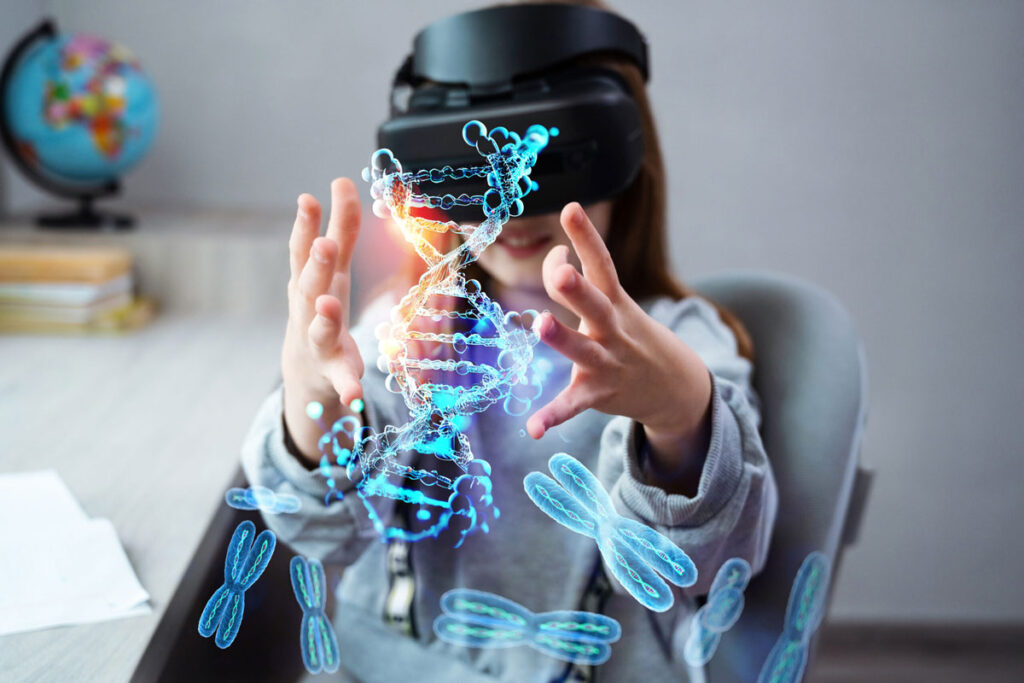
An agent can also provide supportive tools to help students learn, such as a whiteboard, a calculator, or 3D models that visualize the concept, to achieve the learning goal. The same moon becomes a different experience for every student in it, reshaped by adaptive and agentic AI according to what each one needs to learn.
This is different from gamification, where correct answers earn points, badges, or a spot on a leaderboard. It’s different from a simulation, which walks a student through an outcome that’s already decided. Spatial play puts the student inside the problem and lets embodiment do part of the teaching.
Old idea, new tools
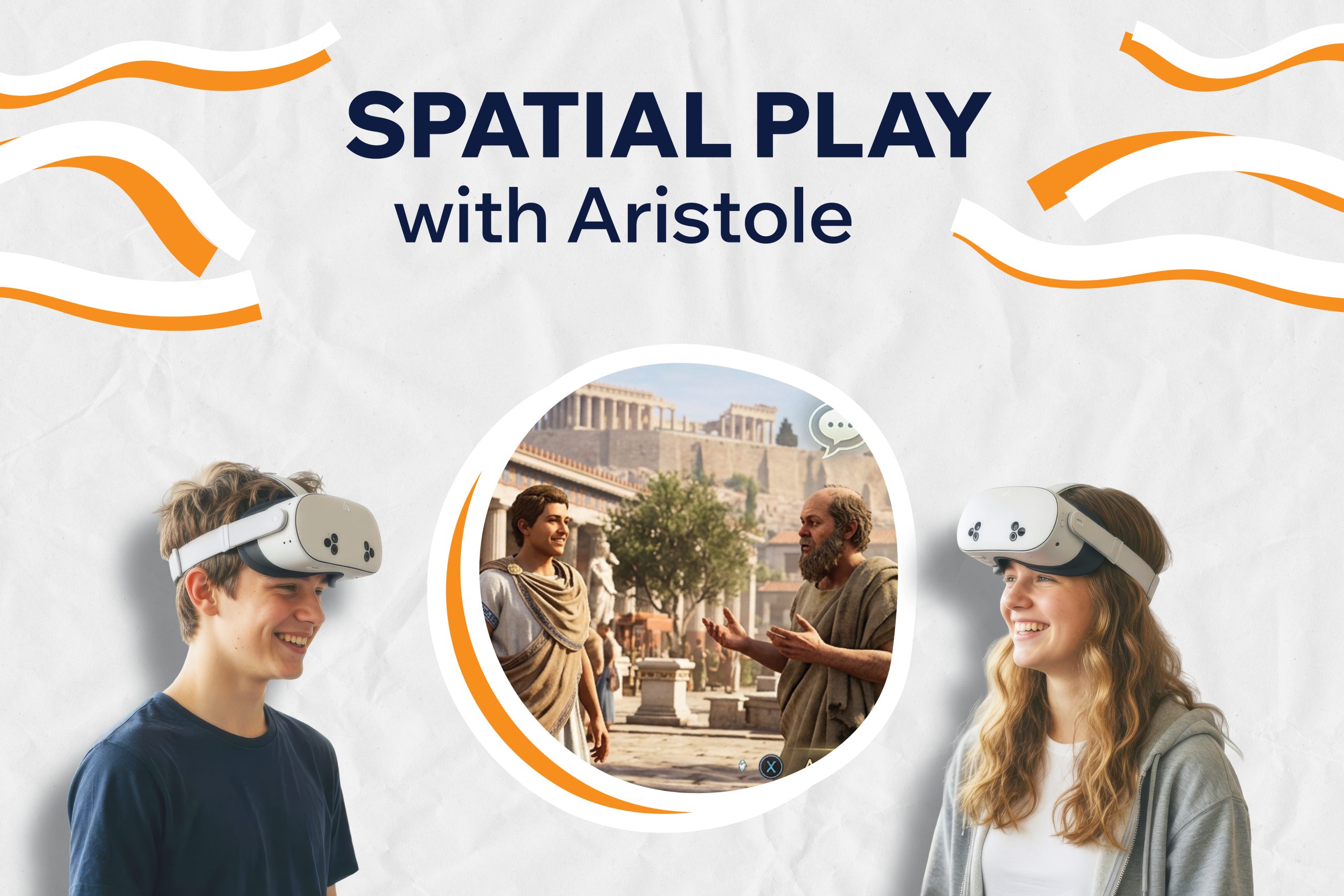
Aristotle argued that virtue is built through repeated action, not lecture. You don’t become courageous by hearing about courage. You become courageous by acting courageously, in small ways, until it’s a habit. Montessori built entire classrooms around the belief that children think with their hands before they think with abstractions. Vygotsky located learning in the space between what a child can do alone and what they can do with the right support beside them, embedded in a shared activity.
None of them had a headset. But each of them would have understood what was happening on that moon.
At OAO, we build our culture around Seven Pillars of Virtue, and two of them were doing quiet work in Mr. Birchum’s classroom without anyone announcing it. Courage, because running out across an unfamiliar lunar surface with your classmates watching takes a small, real kind of nerve. Perseverance, because building “the longest grammatically correct sentence” is a competition you lose a few times before you win it. Nobody delivered a lesson on courage or perseverance that morning. Students rehearsed both, because the space required it.
Embodied action, repeated inside a real context, is the old principle. It builds capability faster and more durably than being told about it. Spatial play is just the newest room we’ve built for that principle to live in.
The location has to matter
Often, VR spaces are used only as background material. A lot of immersive content is a video with extra steps: students watch, they don’t act, and the space has no relationship with what the students are doing. Spatial play requires that the location be critical to the problem. On the moon, gravity and distance and “home” all mattered mechanically, not thematically. Take away the location and the lesson falls apart.
That’s the test I’d offer any school evaluating an immersive tool: if you stripped out the location, would the problem still make sense? If yes, you bought a video game with a headset. If no, you built spatial play.
The classroom data shows spatial play builds academic growth. Our students in grades 6 through 8 with regular immersive access have shown iReady growth averaging 236 to 238 percent of a typical year, compared to 87 to 96 percent for peers with limited access. The numbers point to the same conclusion as the moon lesson.
This also changes what we ask of adaptive and agentic AI. In a spatial play environment, their job is to shape the environment in real time, harder words for a student ready for them, a well-timed nudge from an agent for a student who’s stuck, so the location keeps generating the right problem for the right kid without a teacher having to script forty individual moon surfaces by hand.
This particular moon held a social hour game. The same location, in an actual classroom, could hold something with real stakes, a crashed supply crate or directions for a moon base that have to work, not just make everyone laugh. The rigor changes. The location’s job doesn’t.
The moon was the point
Mr. Birchum built a place where grammar was the only way to win. Our students used courage and perseverance because running across that surface and building a sentence that held up took both, and they rose to the challenge.
That’s spatial play. It’s Aristotle with better equipment.
What’s a moment in your classroom where the location itself, not the worksheet, taught the lesson? I’d love to hear examples from your own classroom.