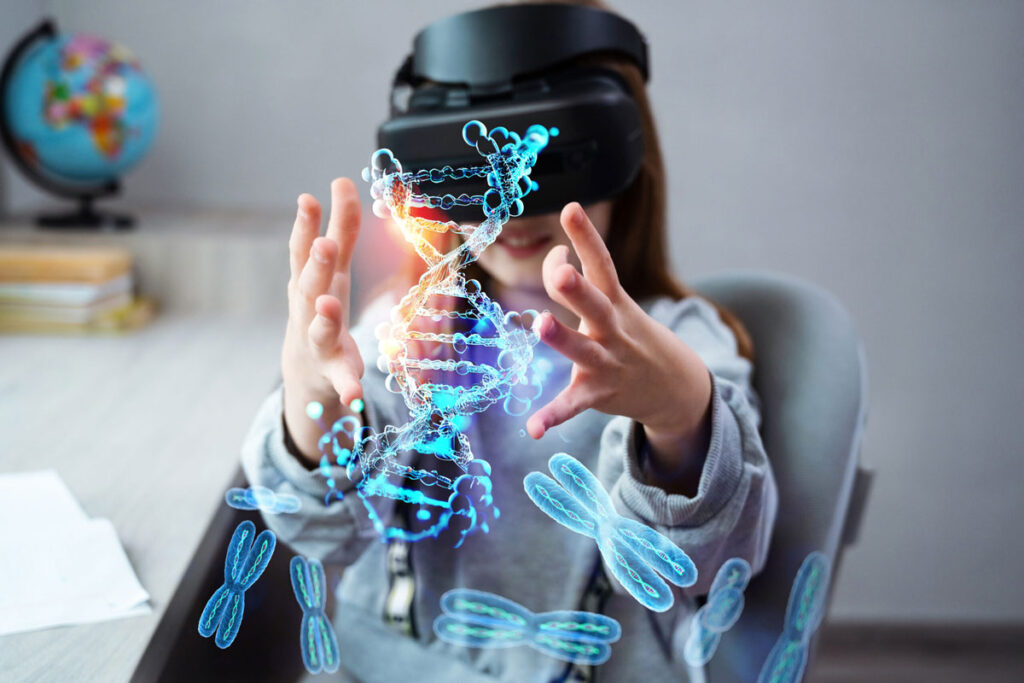
Picture two Scholars sitting down after dinner. One puts on a headset and finds herself standing inside a beating human heart, watching valves open and close around her as blood rushes past. The other opens YouTube and watches a well-produced video of the same heart, narrated by a friendly host with good graphics.
Both kids just learned something about cardiac anatomy. Only one of them will remember it a year from now.
That’s not a knock on video. It’s just not built to do what VR does. Since “VR” and “screen time” get lumped together so often, it’s worth asking directly: what actually makes a VR lesson different from watching a video, or, for that matter, playing a video game?
The Difference Is Presence, Not Just Pixels
A YouTube video, however well made, is something a student watches happen to someone else, somewhere else. A video game is something a student controls, but usually toward a goal the game defines, like points, levels, or a win condition, not necessarily a learning objective.
VR does something neither of those formats can: it puts the learner’s own body inside the content. Researchers call this presence: the felt sense of actually being somewhere, rather than looking at a picture of it. The Cognitive Affective Model of Immersive Learning (CAMIL), a research-based framework published in Educational Psychology Review, argues that this sense of presence is precisely what triggers deeper cognitive processing than flat media can produce.
That distinction matters more than it sounds like it should, because presence changes what the brain does with information, not just how fun the experience feels.
The Retention Gap Is Not Small
Here’s where the difference between “watching” and “experiencing” becomes measurable. A National Training Laboratory study found that lectures and reading produce only 5% to 10% learning retention rates, while a VR experience can result in 75% retention, second only to learning by teaching someone else.
That gap shows up outside the classroom, too. Staff trained with VR at a Miami children’s hospital retained nearly 80% of what they learned when tested a year later, compared to just 20% retention a week after traditional training. A video can be watched attentively and still slip away by Friday. A VR experience tends to stick because the brain filed it under “something I did,” not “something I saw.”
Video Games Are Built for Engagement. VR Is Built for Transfer.
To be fair to video games, they’re genuinely engaging, and that’s not nothing. Engagement in a game, however, is usually in service of the game’s own internal reward system, so the skills don’t always transfer to the subject a student is supposed to be learning.
Educational VR is engineered differently: the immersive environment is the curriculum. A Stanford University study comparing immersive VR videos to conventional videos with middle-school students found that the VR group showed improved knowledge creation and self-efficacy over traditional video, meaning Scholars didn’t just absorb facts; they left more confident in their own ability to use them.
That confidence effect shows up elsewhere in the research, too. PwC found that VR learners were 150% less distracted and 40% more confident than their classroom-only peers, a striking pairing, since distraction and confidence usually move in the same direction, not opposite ones.
It Changes How Students Feel About What They’re Learning, Not Just What They Know
A video can inform a student. A game can entertain one. VR tends to do something closer to move them. Research reviewed in the Research Hub shows that immersive VR can change learners’ perceptions, attitudes, and empathy levels. Walking through a historical event or standing inside another person’s circumstances creates an emotional foothold that a screen recap doesn’t.
Academically, that emotional engagement pays off in concrete outcomes. Research published in Educational Psychology Review found VR leads to increased interest in course material, higher engagement, and better performance on long-term assessments of learning. Studies on physics instruction found that over 90% of students in a VR-supported course reported that the technology helped them understand and visualize 3D vectors, a notoriously hard-to-picture concept in a textbook. At Arizona State University, biology courses using VR technology also saw measurable improvement in both grades and student ratings of the course.
Where This Shows Up at Optima Academy Online
This is exactly why VR at OAO isn’t a novelty add-on or a reward for finishing worksheets. It’s woven into the instructional model starting in upper elementary. When a Scholar steps into a VR field trip to the Great Barrier Reef or a 3D model of the solar system, they’re not watching a substitute for a lesson. They’re doing the lesson, in the format the research says actually builds durable understanding.
Classical education has always been built around the idea that students learn best by actively engaging with ideas: through dialogue, through doing, through direct encounter with a subject rather than a passive summary of it. VR happens to be a remarkably good tool for exactly that, which is part of why it fits so naturally inside OAO’s model rather than sitting alongside it.
A video can show a Scholar the Colosseum. A game can let them “explore” a stylized version of it. VR can put them inside its walls, looking up at where 50,000 people once sat, and the research suggests that difference is exactly what makes the memory last.