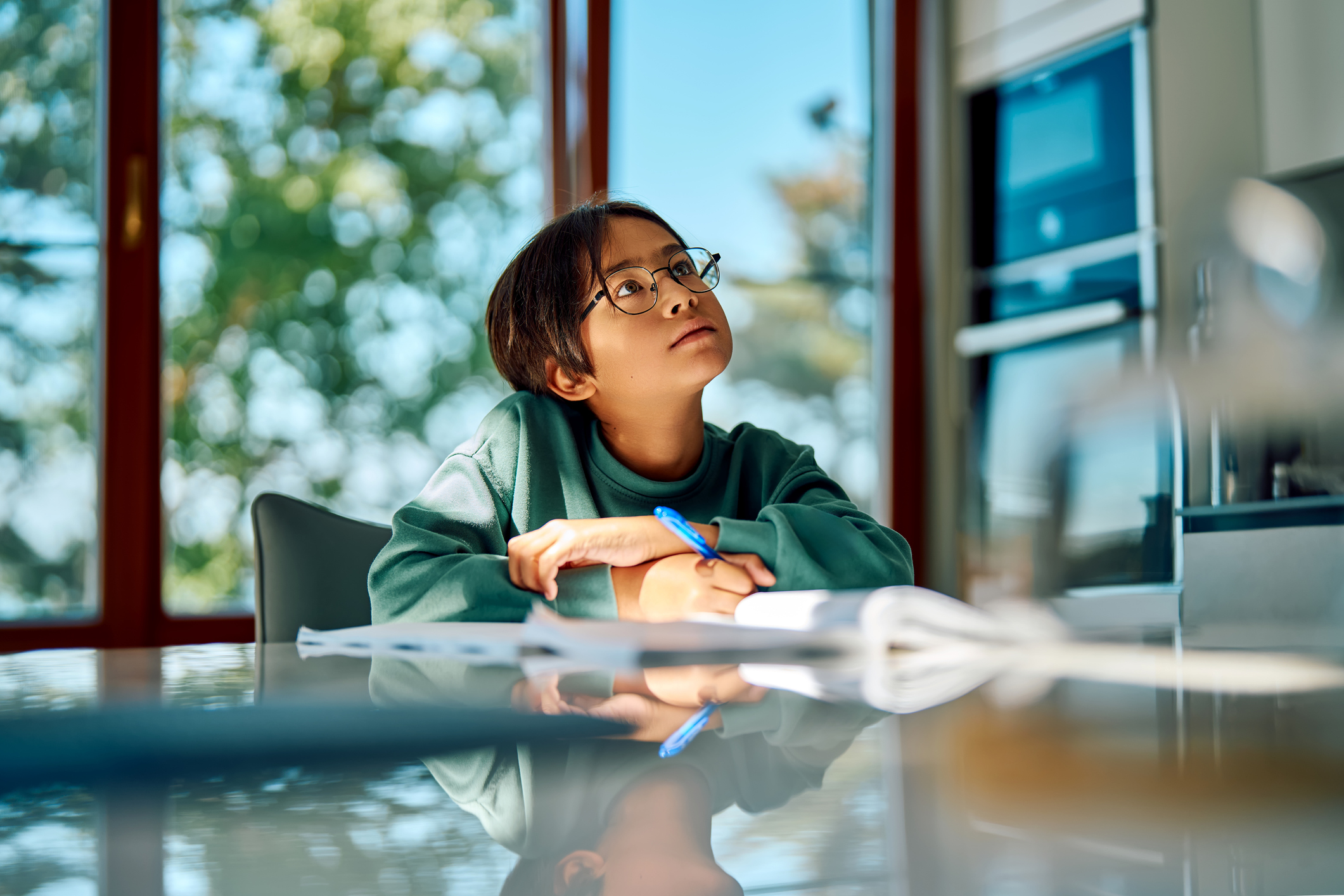
You know your child is capable. You have seen it. Maybe they figured out a complex video game mechanic at age 7, or spent hours building an intricate Lego city with zero instruction. Maybe they read years above grade level, or ask questions that stop adults in their tracks.
Yet when it comes to school, something shuts down. Mornings become battles. Homework turns into tears. A child who lights up with curiosity at home goes flat within minutes of opening a textbook.
If this sounds familiar, you are not imagining it. Many bright children genuinely struggle with traditional schooling, not because something is wrong with them, but because the environment was not designed with them in mind.
Why Smart Children Often Disengage First
Counterintuitively, high ability can be one of the leading causes of school disengagement. When a child already grasps a concept the class is still introducing, they spend the majority of their day waiting. Repetition replaces discovery. Sitting quietly replaces thinking. Over time, a child who once loved learning can begin associating school with boredom, frustration, or even a sense of inadequacy when their energy is repeatedly labeled as a problem.
Psychologists and educators have a name for this pattern: underchallenge. It is not the same as having an easy day. Chronic underchallenge can look like behavioral issues, chronic fatigue, anxiety, or a deep and growing resistance to anything academic. Parents are often told to “give it time” while their child quietly decides school is not a place for them.
At the same time, some bright children struggle for the opposite reason: school moves too fast in areas where they have not yet built strong foundations, while not engaging them in areas where they shine. A scholar who is mathematically advanced but still developing reading fluency can feel perpetually behind even when they are anything but.
What Traditional School Is Not Built to Do
Most conventional schools operate on a one-pace, one-place, one-style model. Scholars sit in age-grouped classrooms, move through curriculum on a fixed schedule, and are evaluated on standardized measures regardless of their individual learning profile. For children who fit neatly into that model, it works reasonably well.
For many bright, curious, or differently wired scholars, it does not. These children often need room to go deeper, not just faster. They benefit from being asked why, not just what. They require environments that meet them where they are rather than asking them to suspend engagement until the class catches up.
It is worth naming what this is not: a parenting failure, a discipline issue, or a sign that a child is destined to struggle. A child who hates school is often a child who has not yet found the right school.
Bright scholars do not need less rigor. They need rigor that is matched to their level, delivered in a way that respects their pace and curiosity.
Signs Your Child May Need a Different Environment
Every scholar is different, but some patterns show up consistently in bright children who are disengaging from traditional schooling. Consider whether your child:
- Completes work quickly but has little to do afterward and grows restless
- Reports feeling bored almost daily
- Is frequently labeled as disruptive, distracted, or unmotivated
- Thrives in self-directed activities outside school but shuts down inside the classroom
- Complains of stomachaches or anxiety specifically on school days
- Has stopped talking about things they used to find exciting
- Resists learning anything associated with school even outside of school hours
If several of these resonate, it may be time to look beyond troubleshooting the current environment and toward finding a fundamentally different one.
What Actually Helps: Environment, Not Just Attitude
Parents often receive advice centered on their child’s attitude: push through, build resilience, learn to sit with discomfort. Perseverance matters, and there is real value in learning to navigate challenges. However, there is a meaningful difference between productive struggle and chronic misalignment.
Research consistently shows that engagement drives learning. A child who is genuinely interested in what they are studying retains more, thinks more critically, and develops stronger habits of mind than a child who is simply complying. Motivation is not a switch parents can flip. It follows from meaningful, appropriately challenging experiences.
What many bright, disengaged scholars need is not a mindset adjustment. They need an environment designed to work with how they actually learn. That means flexible pacing, content with depth and substance, teachers who know their scholars individually, and learning experiences that feel relevant to their real lives.
A Different Kind of School: What OAO Offers
Optima Academy Online was built on a foundational belief: there is a better way to do school. Not a shortcut or a lowered standard, but a reimagined approach rooted in classical education, immersive technology, and genuine flexibility.
OAO scholars study from a classical curriculum grounded in the Great Books and Singapore Math, guided by certified teacher-facilitators in live and self-guided, structured instruction. Classes are small, relationships are real, and the curriculum is designed to challenge scholars rather than simply pace them through content.
Starting in 3rd grade, OAO integrates virtual reality as a core learning tool, not a reward or an add-on. Scholars visit ancient Rome, conduct virtual science labs, and explore subjects in ways that make abstract concepts tangible and memorable. For a child who has been falling asleep in a traditional classroom, this kind of immersive learning can be genuinely transformative.
OAO’s four-day school week and shorter daily schedule give scholars time to pursue their own interests, breathe, and reconnect with learning as something that belongs to them. There is no weekend homework and no sense that education is something happening to them from 7 a.m. to 3 p.m., Monday through Friday, until they are 18.
For families with scholars who have unique learning needs, OAO offers ESE-certified educators, IEP support, and dyslexia-friendly VR tools, as well as a Purple Star School designation recognizing support for military families.
OAO is Cognia-accredited and recognized as the world’s first VR school of record. Scholars graduate with a rigorous private school diploma earned in an environment designed to keep them engaged.
What Families Say About Making the Switch
Parents who enroll with OAO often describe the first few weeks as a recalibration period. Scholars who spent years in survival mode at a traditional school sometimes need time to remember that learning can be something they actually want to do.
What follows, according to families who have made the transition, tends to look like a child coming back to life academically. They start asking questions again. They stay engaged past the point where they used to check out. They talk about school at dinner in a way they never did before.
That shift does not happen because OAO is easier. It happens because scholars are finally in an environment that respects their intelligence, meets their curiosity, and gives them structure that supports rather than suffocates.
Your Child Does Not Have to Hate School
If your child is smart, capable, and still dreads every school day, it is worth asking whether the answer is a different school rather than a different child. Optima Academy Online is enrolling scholars now, and the path to getting started is straightforward.
Attend a family information meeting to meet our team, ask questions, and see what OAO looks like in practice. Your scholar deserves an education that was built for them.