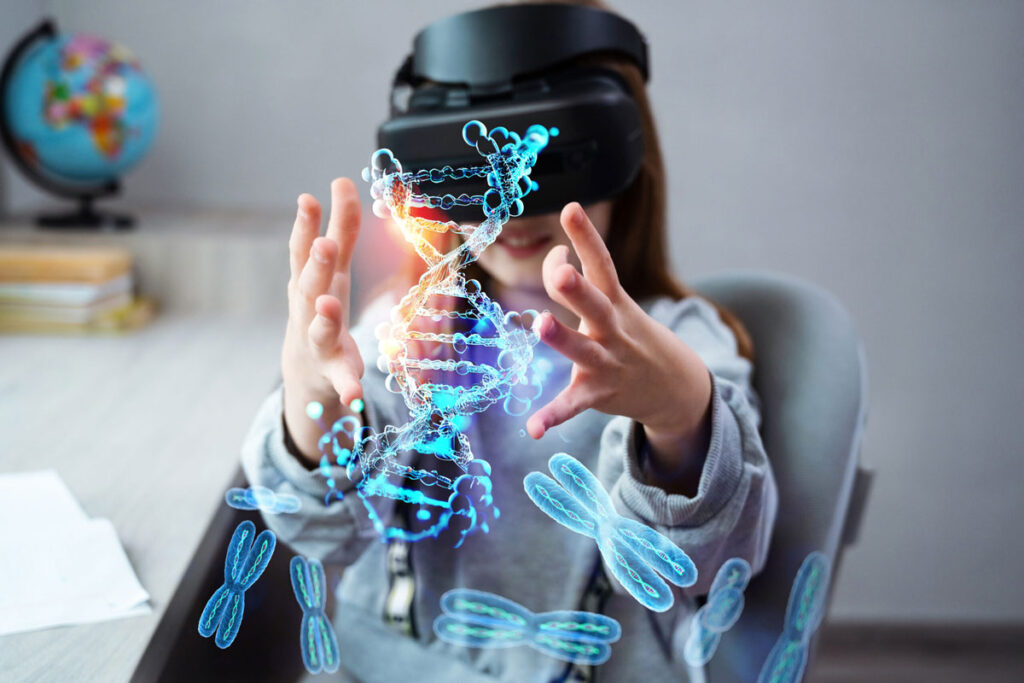
“Another hour on the screen?”
If you’ve felt that pang of guilt watching your child log into their online classes, you’re not alone. Parents today are caught in a confusing paradox: we’re told to limit screen time, yet education increasingly happens on screens. It feels like we’re breaking the rules even when we’re following them.
But here’s what’s getting lost in the conversation: screen time isn’t the problem. It’s what’s happening during that time that matters.
Digital learning isn’t the same as scrolling TikTok, binge-watching YouTube, or mindlessly tapping through games. The screen is just the tool. What matters is the purpose behind it.
The Screen Time Panic: Where It Comes From
Warnings about screen time are everywhere. Too much screen exposure, we’re told, leads to attention problems, sleep disruption, social isolation, and developmental delays. And there’s truth to these concerns—when we’re talking about certain types of screen use.
Research that raised red flags about screens was primarily focused on passive consumption and addictive design. We’re talking about autoplay features that keep kids watching “just one more” video, social media algorithms engineered to maximize engagement, and games designed with the same psychological tactics used in casinos.
That kind of screen time? Yes, that’s worth limiting.
But grouping educational screen time into the same category is like saying reading a book and staring at a blank wall are the same because they’re both “sitting still.”
What Makes Digital Learning Different
 When your child is engaged in quality online learning, their brain isn’t in passive consumption mode. They’re actively problem-solving, creating, analyzing, and producing. The cognitive processes at work are fundamentally different.
Active vs. Passive Engagement
Watching a YouTube compilation of funny cat videos requires minimal cognitive effort. Your brain is in receive-only mode. Digital learning, by contrast, demands active participation. Students are answering questions, writing responses, solving problems, and demonstrating understanding. They’re building knowledge, not just absorbing entertainment.
Structured vs. Endless
Social media and entertainment platforms are designed to be bottomless. There’s always more content, always another video, always another level. They exploit what psychologists call “variable rewards” to keep users hooked. Digital learning has clear beginnings, middles, and ends. Lessons conclude. Assignments have submission points. There’s structure and completion, not infinite scrolling.
Educational Goals vs. Engagement Metrics
Entertainment platforms succeed when they keep eyes glued to screens as long as possible. Their algorithms prioritize watch time above all else. Educational platforms succeed when students learn and grow. The metrics that matter are comprehension, skill development, and academic progress—not minutes watched.
Mentored vs. Unsupervised
When kids are gaming or on social media, they’re often navigating complex digital landscapes alone. In digital learning environments, there’s guidance. Teachers provide direction, feedback, and support. The experience is mentored and purposeful.
The Real Question: Is This Time Well Spent?
Instead of asking “How much screen time is my child getting?” try asking: “What is my child accomplishing during this time?”
Consider two scenarios. In one, your child spends an hour watching random videos, clicking from one recommendation to the next, passively absorbing whatever the algorithm serves up. In another, your child spends an hour in an interactive science lesson, conducting a virtual lab experiment, documenting observations, and discussing findings with their teacher.
Both involve a screen. Both take an hour. But these experiences couldn’t be more different.
One is consumption without purpose. Another is learning with intention. One leaves your child’s brain in neutral while the other puts it in gear.
The Power of Purposeful Technology Use
Some of the most valuable skills your child will need in their future can only be developed through technology. Digital literacy, online collaboration, information evaluation, typing proficiency, digital communication: these aren’t optional anymore. They’re foundational.
When children engage with technology purposefully through digital learning, they’re not just learning math or reading. They’re also developing critical digital citizenship skills. Learning how to use technology as a tool for creation and growth rather than just consumption becomes part of their education.
Consider this: a carpenter’s apprentice needs to spend time with their tools. A musician needs hours with their instrument. In our digital world, screens are the tools your child will use to build their future. Whether they should use them isn’t the question—how they should use them is what matters.
What Quality Digital Learning Looks Like
Not all educational screen time is equal either. High-quality digital learning has specific characteristics that separate it from edutainment or digital busywork.
Interactivity and Engagement: Students are actively participating, not passively watching. They’re making choices, solving problems, and creating content.
Personalization: The learning adapts to your child’s pace and needs. If they’re struggling, they get additional support. If they’re excelling, they get appropriately challenging material.
Real Feedback: Students receive meaningful responses to their work, not just automatic grading, but thoughtful feedback that helps them improve.
Human Connection: Even in digital spaces, there are real teachers providing instruction, answering questions, and building relationships with students.
Clear Learning Objectives: Every activity has a purpose. There’s a reason your child is doing what they’re doing, and it ties to specific learning goals.
Balancing the Digital and Physical
 This isn’t an argument for unlimited screen time or suggesting that all learning should be digital. Balance matters, and the best online learning programs understand this.
Many quality digital learning platforms incorporate offline activities. Students might complete a digital lesson on ecology, then go outside to observe their local ecosystem. They might learn about geometry online, then build three-dimensional shapes with household materials. Digital learning can be a starting point that launches physical exploration.
Even pure online time benefits from breaks. Standing up, stretching, looking away from the screen: these aren’t interruptions to learning; they’re part of maintaining the focus and energy that effective learning requires.
Reframing the Conversation at Home
The language we use shapes how children perceive their activities. When we lump all screen use together as something to be guilty about or strictly limited, we send a message that learning online is somehow less valuable than learning from a textbook.
Instead, try distinguishing between different types of screen time in your family conversations:
“Entertainment screen time” is for fun and relaxation: gaming, videos, social media (when age-appropriate). This is the category that needs boundaries and balance.
“Learning screen time” is for education and growth: online classes, educational software, research for projects. This is purposeful work that happens to use a screen as the tool.
“Creative screen time” is for making things: coding projects, digital art, writing, music production. This is active creation, not passive consumption.
When children understand these distinctions, they begin to self-regulate more effectively. They recognize that learning online serves a different purpose than scrolling for entertainment.
Trust the Purpose, Not Just the Timer
Every family needs to find their own balance, and there’s no one-size-fits-all answer for how much screen time is appropriate. But maybe we’ve been asking the wrong question.
Instead of just counting minutes, consider the quality of the experience. Is your child being challenged? Are they engaged and thinking? Are they developing skills and knowledge? Are they working toward meaningful goals?
When the answer is yes, the fact that it’s happening on a screen becomes far less important.
Digital learning represents a fundamental shift in how education can be delivered, but it doesn’t represent a fundamental shift in what education is. It’s still about curiosity, understanding, growth, and connection. The screen is just the delivery method—the same way paper was once a revolutionary technology for sharing knowledge.
Moving Forward With Confidence
At OAO, we recognize that the screen is simply the vehicle, not the destination. Our approach focuses on what matters: meaningful learning experiences that engage students, build real skills, and prepare them for their future. We incorporate active learning, human interaction, clear structure, and purposeful breaks because we understand that quality matters far more than the medium.
Your child’s education is evolving, and that’s okay. You’re not failing as a parent when your child learns online. You’re embracing the tools that will prepare them for the world they’ll actually inhabit.
Because at the end of the day, we don’t limit our children’s time with books just because they’re printed on paper. We celebrate when they read because of what happens during that time. The same principle applies here.
It’s not about the screen. It’s never been about the screen. It’s about the learning, the growth, and the possibilities that unfold when purpose meets technology.